




Blog / Wilmington Chevrolet Dealer

Bad Credit Pickup Truck Financing Near Wilmington, IL: Your Complete Guide to Getting Approved

If you're looking for bad credit pickup truck financing near Wilmington, IL, you may be wondering whether buying the truck you need is even possible. The good news is that yes, you can finance a pickup truck with bad credit.

Your credit score is only one part of the approval process. Many lenders evaluate your complete financial picture, including your income, employment history, debt-to-income (DTI) ratio, down payment, and overall stability.

At Arnie Bauer Chevrolet GMC in Wilmington, IL, we know that life happens. Medical bills, divorce, job changes, or past financial setbacks shouldn't prevent you from owning a dependable truck. That's why we partner with a network of over 20 trusted local and national lenders offering flexible bad credit auto loans.

Whether you're shopping from Wilmington, Morris, Coal City, Diamond, Braidwood, Channahon, Minooka, or throughout Grundy and Will County, our finance specialists are here to help you get behind the wheel.

Can You Finance a Pickup Truck with Bad Credit?
Yes, absolutely.

Many banks and subprime auto lenders approve truck loans for buyers with less-than-perfect credit every single day. Rather than focusing solely on a credit score, lenders evaluate your current ability to make on-time monthly payments.

What Do Auto Lenders Look At for Approval?

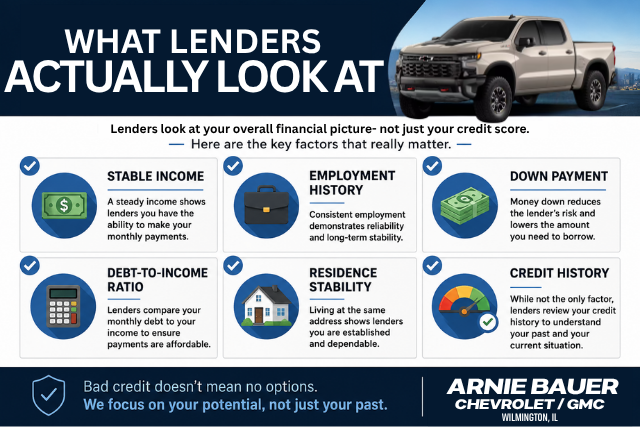
When reviewing a bad credit auto loan application, underwriters evaluate several key factors:

  • Stable Monthly Income: Most subprime lenders look for a minimum gross income of $1,500 to $1,800 per month (before taxes).
  • Employment History: Consistent employment—typically at least 6 consecutive months at your current job or 2+ years in the same line of work.
  • Debt-to-Income (DTI) Ratio: Your total monthly debt obligations (including your estimated new truck payment) should ideally stay below 45%–50% of your gross monthly income.
  • Down Payment Amount: Providing cash or trade-in equity directly lowers the lender’s risk.
  • Residence Stability: Proof of living at your current address for at least 6 to 12 months.
  • Previous Credit Performance: A history of making on-time payments on past auto loans carries significant weight with underwriters.

Even if your credit score is below 600, strength in these areas can significantly improve your approval odds.

What Credit Score Do You Need to Buy a Pickup Truck?

There is no single minimum credit score required to finance a pickup truck at Arnie Bauer Chevrolet GMC.

Every lender operates with different risk guidelines, and our lending network covers every credit tier:

  • Super Prime (720+): Prime rates and maximum lender flexibility.
  • Prime (660–719): Competitive interest rates and flexible loan terms.
  • Near Prime (620–659): Standard auto financing options.
  • Subprime (580–619): Specialized bad credit truck financing options.
  • Deep Subprime (Below 580): High-approval programs focused on income and down payment strength.

If you have experienced severe financial hardship—such as Chapter 7 or Chapter 13 bankruptcy, repossession, medical debt, or late payments—specialized loan programs are still available. Working with a dealership like Arnie Bauer Chevrolet GMC gives you access to multiple lending partners instead of relying on a single bank.

4 Proven Ways to Improve Your Bad Credit Approval Odds

1. Establish a Realistic Monthly Budget

Before test-driving, calculate a comfortable monthly vehicle budget. Remember to factor in total ownership costs:

  • Auto insurance premiums
  • Fuel costs
  • Routine maintenance and unexpected repairs
  • Registration, title fees, and Illinois state sales tax

2. Aim for the "10% or $1,000" Down Payment Rule

Putting money down is one of the most effective ways to secure an approval. Subprime lenders typically look for $1,000 or 10% down (whichever is lower). Cash or trade-in equity:

  • Lowers your total loan amount
  • Reduces your monthly payment
  • Offsets initial depreciation
  • Significantly increases lender approval confidence

3. Bring the Required Documentation

Having your paperwork organized speeds up the subprime approval process. Most specialized lenders require:

  • Proof of Income: Recent pay stubs (showing year-to-date earnings) or 3 months of complete bank statements for self-employed buyers.
  • Proof of Residence: A recent utility bill (electric, gas, or water) or mortgage statement in your name.
  • Valid Driver’s License: Must be active and current.
  • Proof of Insurance: Full coverage insurance listing the lender as the loss payee.
  • Personal References: 5 to 10 personal references with valid contact details (names, addresses, and phone numbers).

4. Consider a Quality Pre-Owned Pickup Truck

If you are actively rebuilding your credit score, opting for a reliable used truck offers strategic financial advantages:

  • Lower purchase price and smaller total loan balance
  • Slower initial depreciation
  • Greater lender flexibility on debt-to-income ratios

Why Chevrolet and GMC Pickup Trucks Are Built for Illinois Drivers

Whether you are commuting along I-55, hauling equipment to a jobsite, towing a boat to the Kankakee River, or navigating severe Midwest winters, Chevrolet and GMC pickups deliver the durability local drivers need.

Chevrolet Silverado 1500

The Silverado 1500 remains a benchmark for full-size pickup performance.

  • Key Features: Available four-wheel drive (4WD), maximum available trailering capacity up to 13,300 lbs, spacious Crew Cab configurations, and modern driver-assist safety tech.

GMC Sierra 1500

The GMC Sierra combines heavy-duty capability with premium refinement.

  • Key Features: Available 3.0L Duramax® Turbo-Diesel engine for maximum fuel efficiency and towing torque, rugged AT4 off-road packages, and luxurious Denali cabin appointments.

Chevrolet Colorado & GMC Canyon

Midsize trucks offer full-size capability with easier daily maneuverability.

  • Key Features: High-capacity towing in a compact footprint, easy parking around town, robust off-road suspensions, and lower overall purchase prices.

Frequently Asked Questions

Can I finance a pickup truck after bankruptcy?

Yes. Many specialized subprime lenders approve buyers immediately following a Chapter 7 bankruptcy discharge. If you are currently in an active Chapter 13 bankruptcy repayment plan, you can also qualify once you receive court trustee authorization.

Can I get approved for a truck loan with no credit history?

Yes. First-time buyer programs evaluate your job stability, monthly income, and down payment rather than relying on a credit score. Having no credit is treated differently than having a history of missed payments.

Will applying for bad credit financing hurt my credit score?

Only temporarily by a few points. Submitting a credit application results in a hard inquiry. However, standard credit scoring models (FICO and VantageScore) group multiple auto loan inquiries made within a 14-to-45-day shopping window as a single inquiry, allowing you to rate-shop safely without damaging your credit.

Can I start the auto financing process online?

Yes. You can safely complete our confidential credit application from home before visiting the dealership.

Why Choose Arnie Bauer Chevrolet GMC in Wilmington, IL?

For generations, the Arnie Bauer family has helped Illinois drivers find reliable vehicles and manageable financing plans. When you work with our finance department, you benefit from:

  • Specialized credit recovery programs tailored to your budget
  • Direct access to over 20 local banks, credit unions, and national subprime lenders
  • A complete inventory of new Chevrolet and GMC trucks plus inspected pre-owned pickups
  • Transparent, pressure-free sales and finance guidance
  • A locally owned dealership committed to Grundy County and Will County communities

Start Your Bad Credit Truck Approval Today

If you've been searching online for:

  • bad credit truck financing near Wilmington, IL
  • pickup truck financing with bad credit
  • can I finance a truck with bad credit
  • truck dealership that works with bad credit near me

...our dedicated finance team is ready to assist you.
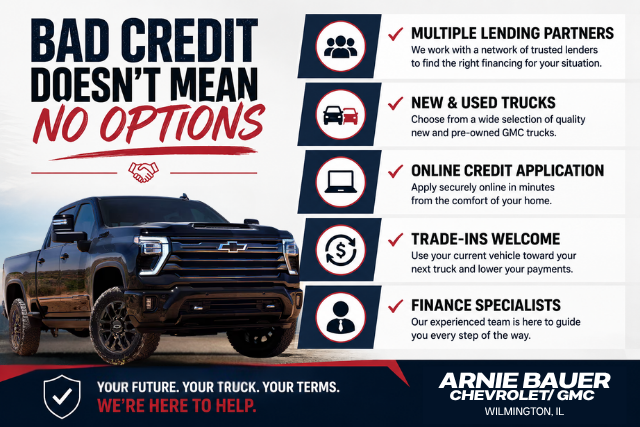
Browse our New Pickup Truck Inventory, explore our Quality Used Truck Selection, or complete our Secure Online Credit Application to get started today!

Visit Our Wilmington Dealership

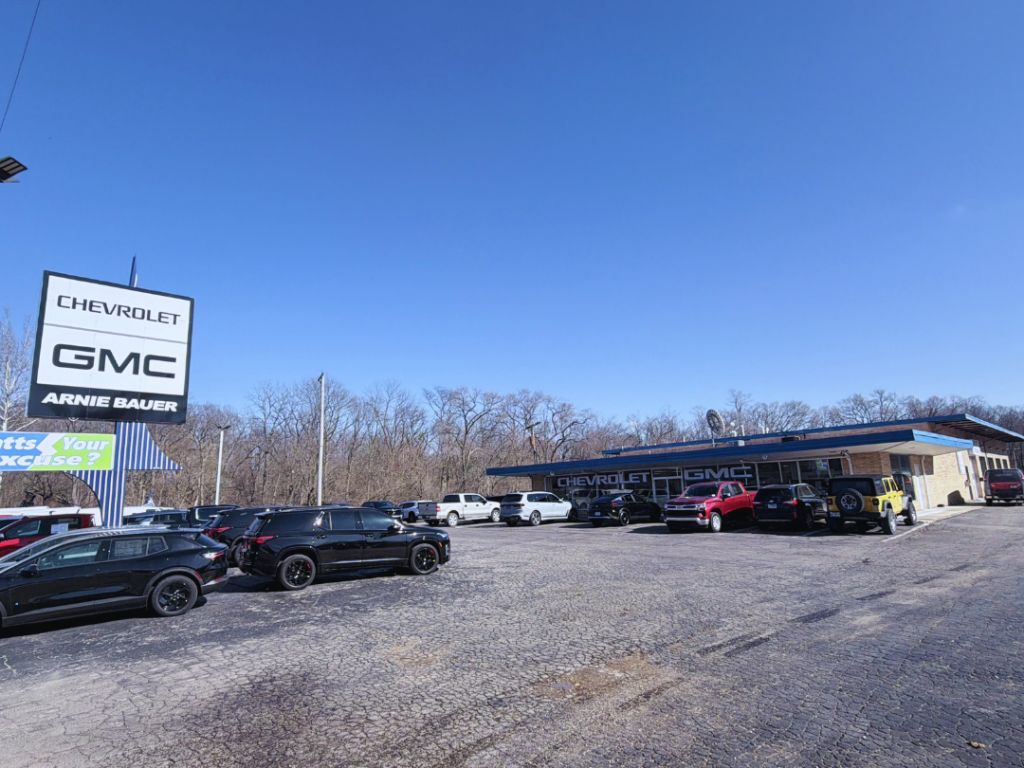
Arnie Bauer Chevrolet GMC

📍 901 E. Baltimore St., Wilmington, IL 60481

📞 Sales & Finance Direct Line: (815) 926-1460

🌐 Serving: Wilmington, Morris, Coal City, Diamond, Braidwood, Channahon, Minooka, Elwood, Grundy County, and Will County.
Posted in:

Related Posts

How to File a GAP Claim After Your Car Is Totaled in Illinois

If your vehicle has been declared a total loss, you may be wondering what happens if your primary auto insurance payment doesn’t cover the full amount you still owe on your vehicle financing. That’s where Guaranteed Asset Protection, commonly known as GAP, may become relevant. At Arnie Bauer Chevrolet in Wilmington, IL, we know this question is especially timely following the recent severe weather that caused significant damage throughout Wilmington, Will County, and surrounding Illinois communities. Whether your vehicle was damaged in an accident, by a fallen tree or branch, during a tornado, or in another severe weather event, here’s what Illinois drivers should know about the GAP claim process after a total loss. Quick Answer: How Do You File a GAP Claim After Your Car Is Totaled? If you have GAP and your vehicle is declared a total loss, start by working with your primary auto insurance company and your lender or financial institution. Once you have information about the total loss and insurance settlement: Report the loss to your primary auto insurance company. Find out whether your vehicle has been declared a total loss. Review the information provided by your insurance company. Contact your lender or financial institution. Locate and review your GAP agreement. Contact the GAP administrator identified in your agreement. Submit the documentation requested by the administrator. Stay in contact with your lender until your account is resolved. Because GAP agreements and individual circumstances vary, your specific GAP agreement determines applicable benefits, terms, conditions, limitations, exclusions, eligibility requirements, and claim procedures. What Is GAP Coverage? GAP stands for Guaranteed Asset Protection. GAP may provide financial protection when a financed vehicle is declared a covered total loss and there is an eligible difference between the amount remaining on the vehicle financing and the amount paid by the primary auto insurer. Here’s a simplified example: Amount owed on vehicle financing: $32,000 Primary insurer pays: $27,000 Difference: $5,000 Depending on the terms of the applicable GAP agreement, GAP may help address some or all of an eligible difference. This is a simplified example for illustration only. Actual benefits depend on the terms of the applicable GAP agreement and the circumstances of the loss. Is GAP the Same as Auto Insurance? You’ll often hear people refer to this protection as “GAP insurance,” which is also a common phrase drivers use when searching online. However, GAP products can be structured differently. Review the GAP agreement you received when purchasing or financing your vehicle to understand exactly how your specific product works. Your individual agreement determines applicable terms, benefits, limitations, exclusions, and claim procedures. Wilmington, IL Tornado and Severe Weather Vehicle Damage Severe weather is an especially relevant concern for drivers in Wilmington and the surrounding area following the storms of August 11, 2026. The National Weather Service Chicago confirmed an EF-1 tornado in Wilmington, Illinois, during the August 11 severe weather event. The tornado had estimated peak winds of approximately 90 mph, a maximum width of 150 yards, and traveled approximately 1.52 miles. According to the National Weather Service damage survey, the tornado began near West Baltimore Street and North 1st Street, crossed the Kankakee River, caused substantial tree damage around Oakwood Cemetery, continued east along Ridge Street, and lifted near Forked Creek Preserve. Severe storms can damage vehicles in several ways, including: Falling trees and branches Wind-blown debris Hail Water or flooding Falling objects Storm-related collisions If your vehicle was damaged during a tornado or severe storm, don’t assume that visible or extensive damage automatically means the vehicle is a total loss. Your primary auto insurance company will evaluate the damage and handle the physical-damage claim according to the terms of your insurance policy. If your insurer determines that the vehicle is a covered total loss and an eligible amount remains on your vehicle financing, GAP may become relevant depending on the terms of your agreement. How to File a GAP Claim After a Total Loss Because GAP agreements and claim circumstances can differ, always follow the instructions contained in your individual agreement and those provided by your GAP administrator. The following steps can help you get started. 1. Report the Loss to Your Primary Auto Insurance Company If your vehicle has been damaged in an accident, tornado, severe storm, flood, fallen-tree incident, or other event, contact your primary auto insurance company first. Follow your insurer’s instructions for reporting and documenting the loss. If you’re dealing with storm damage, photos or videos of the vehicle and surrounding damage may be useful when it is safe to take them. 2. Find Out Whether Your Vehicle Is a Total Loss Your primary insurer will evaluate the damage according to your insurance policy and determine how the physical-damage claim will be handled. GAP does not replace the primary auto insurance coverage that handles physical damage to your vehicle. GAP generally becomes relevant when an eligible financed vehicle has been determined to be a covered total loss and an eligible difference remains after the primary insurance settlement. 3. Review the Information From Your Insurance Company If your vehicle is determined to be a total loss, carefully review the information provided by your insurance company. Make sure basic information about your vehicle is accurate, including its: Year Make Model Trim Mileage If you have questions about the value assigned to your vehicle or how your insurance settlement was calculated, contact your insurance company. 4. Contact Your Lender or Financial Institution Contact the lender or financial institution associated with your vehicle financing. Ask about your current account balance and what you’re required to do while the insurance and GAP processes are being completed. Should I stop making car payments after my vehicle is totaled? Don’t assume that you should stop making payments simply because your vehicle has been declared a total loss or because you are filing a GAP claim. A total-loss determination does not necessarily mean your finance account has immediately been satisfied. Continue following the terms of your finance agreement and your lender’s instructions until your lender confirms otherwise. 5. Locate and Review Your GAP Agreement Find the GAP paperwork you received when you purchased or financed your vehicle. Your individual agreement is important because it establishes the specific: Terms Benefits Eligibility requirements Limitations Exclusions Claim procedures Applicable state-specific provisions Don’t assume that another driver’s GAP coverage, an online article, or a different GAP product has the same terms as your agreement. 6. Contact the GAP Administrator Listed in Your Agreement Locate the GAP administrator or provider identified in your paperwork and contact that company for instructions on initiating a claim. Because GAP products and administrators can differ, use the contact information contained in your individual agreement rather than assuming that a phone number or claim procedure found online applies to your coverage. 7. Submit the Documentation Your GAP Administrator Requests The documents required for a GAP claim can vary depending on the administrator, agreement, lender, insurance company, and circumstances surrounding the total loss. Ask your GAP administrator exactly what documentation is required for your particular claim. Keep copies of the documents and information you submit. If additional information is requested, responding promptly may help keep the process moving. 8. Stay in Contact With Your Lender Continue communicating with your lender while your primary insurance claim and GAP claim are being resolved. Don’t assume your finance account has been satisfied until your lender confirms its status. What If a Tornado Totals My Financed Car in Illinois? If a tornado damages your vehicle, contact your primary auto insurance company first. Your insurer will determine how the physical damage is handled according to your insurance policy and whether the vehicle is considered a total loss. If the tornado damage results in a covered total loss and there is an eligible difference between your vehicle financing and the primary insurance settlement, GAP may become relevant according to the terms of your individual agreement. What If a Tree Falls on My Financed Vehicle? Falling trees and large branches can cause significant vehicle damage during severe storms. If a tree or branch damages your financed car, truck, or SUV, report the loss to your primary auto insurance company and follow its instructions. Your insurer will determine how the physical-damage claim is handled under your policy. If the vehicle is determined to be a covered total loss and there is an eligible difference between the amount remaining on your vehicle financing and the amount paid by your primary insurer, review your GAP agreement and contact the administrator identified in that agreement. Does GAP Cover Flood or Water Damage? Your primary auto insurance policy determines how physical flood or water damage to your vehicle is handled. If the damage results in a covered total loss and an eligible difference remains between the amount on your vehicle financing and the primary insurance settlement, GAP may become relevant according to the terms of your individual agreement. Your GAP agreement determines whether and how benefits apply to your particular situation. What Happens If Insurance Doesn’t Pay Off My Car Loan? This is one of the most common reasons drivers search for information about GAP. The amount paid by a primary auto insurer following a total loss and the amount remaining on a vehicle finance agreement are not necessarily the same. If an eligible difference remains after the primary insurance settlement, GAP may provide financial protection according to the terms and conditions of the applicable GAP agreement. Do not assume, however, that GAP automatically covers every dollar remaining on a vehicle finance agreement. Your individual GAP agreement determines what amounts may be eligible and what limitations or exclusions apply. Does GAP Pay for Repairs After an Accident or Storm? GAP is associated with an eligible total loss. It is not a replacement for the primary auto insurance coverage that handles physical damage to your vehicle. If your vehicle is repairable and is not considered a total loss, your primary auto insurance policy determines how covered repair costs are handled. GAP Claim FAQs for Illinois Drivers How do I file a GAP claim in Illinois? Start with your primary auto insurance company and determine whether your vehicle is a total loss. Contact your lender, review your GAP agreement, and contact the administrator identified in your agreement for instructions on filing your GAP claim. What happens when a financed car is totaled in Illinois? Your primary auto insurer evaluates the loss and handles the insurance claim according to your policy. You should also contact your lender regarding your remaining balance and account requirements. If an eligible difference remains after the primary insurance settlement, GAP may become relevant according to your individual agreement. Does GAP automatically pay off the rest of my car loan? Don’t assume that GAP automatically pays every amount remaining on your vehicle financing. The amount eligible for GAP benefits, along with applicable terms, limitations and exclusions, is determined by your specific GAP agreement. Should I keep making payments after my car is totaled? Don’t stop making payments simply because your vehicle has been declared a total loss. Contact your lender and continue following the terms of your finance agreement and your lender’s instructions while the insurance and GAP matters are being resolved. Can GAP help if a tornado totals my car? Potentially. Your primary auto insurer first determines how the physical-damage claim is handled. If the tornado results in a covered total loss and an eligible difference remains after the primary insurance settlement, GAP may apply according to your individual agreement. Can GAP help if a tree falls on my financed vehicle? Potentially. Report the damage to your primary auto insurer first. If the vehicle is determined to be a covered total loss and the requirements of your GAP agreement are satisfied, GAP may apply to an eligible difference. Does GAP pay for storm damage repairs? GAP is not a replacement for the primary auto insurance coverage that handles physical damage to your vehicle. GAP generally becomes relevant in connection with an eligible total loss rather than ordinary vehicle repairs. What documents do I need for a GAP claim? Requirements vary depending on the GAP administrator, agreement, lender, insurer, and circumstances of the claim. Contact the administrator identified in your GAP agreement and ask exactly which documents are required for your particular claim. How long does a GAP claim take? Processing times can vary depending on the GAP administrator, insurance settlement, lender information, required documentation, and circumstances of the claim. Contact your GAP administrator regarding the status and expected processing of your individual claim. Questions About GAP After a Total Loss? Contact Arnie Bauer Chevrolet in Wilmington, IL Dealing with a totaled vehicle after an accident or severe weather can involve several different parties, including your primary insurance company, lender, and GAP administrator. If you purchased GAP with your vehicle at Arnie Bauer Chevrolet in Wilmington, IL, contact our team with questions about the GAP information provided with your purchase. For questions about whether a particular loss, balance, expense, or circumstance qualifies for GAP benefits, review your individual GAP agreement and contact the administrator identified in that agreement. Arnie Bauer Chevrolet 901 E. Baltimore St. Wilmington, IL 60481 Arnie Bauer Chevrolet proudly serves drivers in Wilmington and surrounding communities, including Braidwood, Coal City, Diamond, Morris, Channahon, Minooka, Will County, Grundy County, and nearby areas. Important GAP Disclosure GAP products are optional, and terms can vary depending on the specific product and agreement. This article is provided for general informational purposes only and is not a statement or guarantee of coverage. Your individual GAP agreement governs applicable benefits, terms, conditions, eligibility requirements, limitations, exclusions, claim procedures, and state-specific provisions. Contact the administrator identified in your agreement regarding your specific claim or GAP benefits.

Fast Chevrolet Cars: Explore New and Used Chevy Performance Vehicles Near Wilmington, IL

Few automakers have a performance legacy as recognizable as Chevrolet. From the iconic Corvette and Camaro to today’s electrified performance models, Chevy has spent generations proving that exhilarating speed comes in many forms. If you are searching for fast Chevrolet cars near Wilmington, Illinois, Arnie Bauer Chevrolet can help you find a vehicle that matches your performance goals, driving preferences, and budget. Whether you want a new Corvette, a pre-owned Camaro, or an electric vehicle with instant acceleration, there is a fast Chevy built for the exact experience you have in mind. What Is the Fastest Chevrolet Car? The Chevrolet Corvette sits at the top of the brand’s performance lineup. However, Corvette is not a single performance level. The C8 lineup includes several distinct models, each offering a unique combination of acceleration, handling, horsepower, and everyday drivability. Chevrolet Corvette Stingray The Corvette Stingray is the entry point into Chevrolet’s mid-engine sports car lineup, but its performance is anything but ordinary. With up to 495 horsepower from its 6.2-liter V8 engine, the Stingray delivers the perfect balance for Illinois drivers: serious speed, responsive handling, head-turning design, and enough practicality to enjoy beyond special occasions. It is an excellent choice for weekend drives through Grundy County, summer road trips, and everyday cruising. Chevrolet Corvette E-Ray The Corvette E-Ray combines a 6.2-liter V8 engine with an electric front-drive unit to produce a combined 655 horsepower. Its electrified all-wheel-drive (eAWD) system helps the E-Ray launch from 0 to 60 mph in just 2.5 seconds. For performance drivers in Illinois, the eAWD system provides added traction and confidence in changing road conditions. (Note: The E-Ray is a performance hybrid, not a plug-in hybrid or fully electric vehicle). Chevrolet Corvette Z06 Designed with the racetrack in mind, the Corvette Z06 takes a raw, hyper-focused approach to performance. Its naturally aspirated 5.5-liter flat-plane-crank LT6 V8 produces 670 horsepower and screams up to an 8,600 RPM redline. Featuring specialized aerodynamics, Magnetic Ride Control, and upgraded cooling systems, the Z06 is engineered for drivers who prioritize precision track handling and an aggressive exhaust note. Chevrolet Corvette ZR1 & ZR1X The Corvette ZR1 and hypercar-grade ZR1X represent the pinnacle of American supercar engineering. Corvette ZR1: Features a twin-turbocharged 5.5-liter LT7 V8 producing an astonishing 1,064 horsepower, achieving a track top speed of 233 mph. Corvette ZR1X: Pairs that twin-turbocharged V8 with an electrified front axle for an all-wheel-drive output of 1,250 combined horsepower, delivering supercar-level launch times. Is the Chevrolet Camaro Still Available? Chevrolet concluded production of the sixth-generation Camaro following the 2024 model year, meaning it is no longer available to order as a new current-production vehicle. However, pre-owned Camaros remain top contenders for drivers seeking classic muscle-car styling and rear-wheel-drive performance. Depending on current inventory availability, pre-owned Camaro shoppers can explore several distinct trims: Camaro LT: Powered by a turbocharged four-cylinder or an available 3.6L V6, offering sports car styling and agile handling with everyday efficiency. Camaro LT1 & SS: Driven by a 6.2-liter V8 outputting 455 horsepower, delivering classic American V8 rumble, strong linear acceleration, and available manual or automatic transmissions. Camaro ZL1: The ultimate track-ready sixth-gen Camaro, featuring a supercharged 6.2-liter LT4 V8 generating 650 horsepower, track-tuned suspension, and Brembo® performance brakes. Are Any Fast Chevrolet Vehicles Electric? Yes. Instant electric torque has opened an exciting new era for Chevrolet performance. The Chevrolet Blazer EV SS is a high-performance electric SUV that delivers supercar acceleration with daily utility. With Wide Open Watts (WOW) mode activated, the Blazer EV SS produces up to 615 horsepower and 650 lb.-ft. of torque, catapulting from 0 to 60 mph in an estimated 3.4 seconds. It is the ideal option for drivers who want thrilling speed without giving up passenger space, cargo flexibility, or all-weather capability. What to Inspect When Buying a Pre-Owned Performance Vehicle A high-performance car requires a more detailed evaluation than a standard commuter vehicle. Before purchasing a pre-owned Corvette or Camaro, always ensure you or your dealer review: Detailed Vehicle History: Verify routine service records and check for prior collision history via a CARFAX® report. Aftermarket Modifications: Identify whether aftermarket engine tunes, bolt-on parts, or exhaust modifications were professionally installed, as improperly installed modifications can impact reliability or remaining warranty coverage. Brake & Tire Wear: Performance tires and carbon-ceramic or multi-piston brakes experience unique wear patterns. Ensure adequate tread depth and rotor life remain. Pre-Purchase Inspection: Choose a dealership with GM-certified technicians capable of inspecting track wear, suspension bushings, fluid conditions, and overall mechanical integrity. Don't See the Exact Vehicle You Want? We Acquire It for You! At Arnie Bauer Chevrolet, our available inventory changes quickly—especially when it comes to rare Corvette allocations, low-mileage Camaros, or specialty EV performance trims. If we do not currently have your dream car on our lot, our search doesn't stop there. We offer complete vehicle procurement services tailored to your exact specifications: 1. Custom Factory Orders (New Chevy Models) When ordering is open for eligible new Chevrolet models (including Corvette, Blazer EV SS, and Silverado performance trims), our team assists you in building your vehicle straight from the factory. Select your exact interior finish, exterior paint, performance package, and gearing choices for direct priority production. 2. Extensive Dealer & Auction Sourcing (Pre-Owned Performance) Looking for a specific pre-owned Camaro ZL1, a manual-transmission SS, or a low-mileage Corvette trim? We leverage our extensive dealer network and search wholesale dealer auctions on your behalf to find, acquire, and bring the exact vehicle right to our Wilmington showroom. Contact us today to discuss your options and timeline. Visit Arnie Bauer Chevrolet in Wilmington, IL Ready to experience Chevrolet performance firsthand? We invite you to visit Arnie Bauer Chevrolet at 901 E. Baltimore Street in Wilmington, IL. Stop in today to explore our current selection of new and pre-owned performance models, take a test drive, and speak with our team. If we don't have the exact new or used vehicle you are looking for on our lot, let us know—we will custom build it or locate and acquire it through our nationwide network! Frequently Asked Questions About Fast Chevrolet Cars What is the fastest Chevrolet car? The Corvette ZR1 and ZR1X represent the pinnacle of Chevrolet performance. The 1,064-hp ZR1 reaches track speeds up to 233 mph, while the 1,250-hp electrified all-wheel-drive ZR1X delivers blistering sub-2-second 0-60 mph launch performance. Can I still buy a new Chevrolet Camaro? No. Production of the sixth-generation Camaro ended after the 2024 model year. However, Arnie Bauer Chevrolet can help locate specific pre-owned Camaro models across our regional network and wholesale auctions. Can Arnie Bauer Chevrolet order a custom Corvette? Yes. Subject to factory production allocations and model availability, our team can guide you through a custom order build for eligible new Corvette models. What if the dealership doesn't have the specific car or trim I want in stock? If it's not on our lot, we can acquire it. We can set up a new vehicle custom order directly with Chevrolet or search nationwide dealer auctions to source the exact pre-owned trim, color, and option package you desire. Where is Arnie Bauer Chevrolet located? We are located at 901 E. Baltimore Street, Wilmington, IL 60481, serving performance car enthusiasts across Wilmington, Diamond, Coal City, Morris, and Grundy County.

2026 Chevy Silverado EV | Electric Truck | Chevrolet

How to Check Battery Health Before Buying a Used EV in Wilmington, IL

Your Complete Guide to Buying a Used Electric Vehicle Near Wilmington, Morris, Coal City, Diamond, and Surrounding Illinois Communities Buying a used electric vehicle (EV) is one of the most cost-effective ways to enjoy instant torque, lower operating costs, and cutting-edge tech without paying new-car prices. But unlike evaluating a traditional gas-powered car, the single most critical component to inspect on a pre-owned EV is its high-voltage lithium-ion battery. At Arnie Bauer Chevrolet GMC in Wilmington, IL, we help drivers throughout Wilmington, Morris, Coal City, Diamond, Braidwood, Channahon, Minooka, and Grundy County shop for quality used electric vehicles with total confidence. Whether you are eyeing a pre-owned Chevrolet Bolt EV, Chevrolet Equinox EV, Chevrolet Blazer EV, Chevrolet Silverado EV, GMC HUMMER EV, GMC Sierra EV, or another used electric car, understanding battery condition is essential before taking delivery. Why Battery Health Matters on a Pre-Owned EV The high-voltage battery system is the heart and most valuable component of any electric vehicle. Over time, all lithium-ion EV batteries experience a slow, gradual reduction in maximum storage capacity, known as battery degradation. This is a normal chemical aging process common to all EVs. According to industry studies, modern EV batteries lose an average of only 1% to 2% of capacity per year under typical driving and charging conditions. A battery's overall health directly impacts: Total Driving Range: How many miles you get on a full charge. Charging Rate Performance: How efficiently the battery accepts rapid DC Fast Charging. Resale & Trade-In Value: The long-term market value of the vehicle. Ownership Costs: Minimizing out-of-pocket battery repairs down the road. Fortunately, modern EV batteries are liquid-cooled and thermally managed to last over 100,000 to 150,000 miles while retaining a major portion of their original driving range. What Is EV Battery State of Health (SOH)? When shopping for a used EV, the most critical metric to look for is State of Health (SOH). State of Health (SOH) is a percentage representing how much usable energy capacity remains in the battery compared to when the vehicle rolled off the factory line. 100% SOH: Brand-new condition (or recently replaced under warranty). 90% – 95% SOH: Excellent condition; minimal degradation. 80% – 89% SOH: Typical and expected for a well-maintained, multi-year-old used EV. Below 80% SOH: Warranties may apply; warrants closer inspection of price, age, and owner driving needs. 6 Steps to Check Battery Health Before You Buy 1. Request an Official Battery Health Report The most reliable step is asking the dealership for a diagnostic battery health printout. Established dealerships like Arnie Bauer Chevrolet GMC connect specialized GM diagnostic tools directly to the vehicle’s On-Board Diagnostics (OBD-II) port to pull accurate, module-level battery data rather than relying on educated guesses. 2. Review Estimated Driving Range Realistically Never evaluate a battery based solely on the dashboard range meter (often called the "Guess-O-Meter"). The displayed range fluctuates dynamically based on recent driving history, outside ambient temperatures, cabin heater/AC usage, and tire pressure. Always weigh the displayed range alongside a verified SOH percentage reading. 3. Inquire About Past Charging Habits How the previous owner charged the EV plays a minor role in degradation: Level 1 & Level 2 Charging (Home/Work AC): Gentle on battery chemistry; ideal for daily longevity. DC Fast Charging (Level 3 Public Chargers): Safe and convenient for road trips, but heavy, exclusive use over several years can accelerate minor wear due to heat buildup. 4. Verify Remaining Factory Battery Warranty General Motors provides an impressive 8-year / 100,000-mile Electric Vehicle Component Limited Warranty on modern EVs (which explicitly covers battery capacity retention thresholds, usually guaranteeing against capacity loss greater than 30% to 34% depending on the model year). Confirm the remaining years and mileage, and verify that the warranty automatically transfers to you as the second owner. 5. Inspect the Vehicle History & Service Records Request a CARFAX® or AutoCheck® report. Look specifically for clean title status (avoiding flood or severe structural damage cars that could compromise high-voltage wiring) and verify that all manufacturer safety recalls have been completed by a certified dealership. 6. Take a Multi-Condition Test Drive During your test drive, observe the physical and electrical performance of the EV using this quick inspection matrix: Used EV Pre-Purchase Inspection Matrix EV Feature / Component What to Look For (Good Condition) Potential Red Flag State of Health (SOH) 80% to 95%+ remaining capacity SOH under 70% without remaining warranty Acceleration & Power Instant, silent, and linear throttle response Sluggish acceleration or "Reduced Power" warnings Regenerative Braking Smooth deceleration when easing off the accelerator Jerky transition or illuminated ABS/Brake warnings Charging Port Assembly Clean, damage-free pins; snug latch fitment Scorching, loose housing, or door latch failure Thermal System Silent or normal cooling fan operation Loud, grinding coolant pumps or high battery temp alerts 3 Common Myths About Used EV Batteries Myth #1: High Mileage Means a Blown Battery. Fact: Battery health depends far more on thermal management systems and climate than odometer mileage alone. A high-mileage EV with gentle charging habits can easily outshine a low-mileage EV left uncharged in extreme heat. Myth #2: Replacing an EV Battery Is a Guaranteed Expense. Fact: EV battery replacement rates remain extremely low across the automotive industry. Most owners drive their EVs for over a decade without ever needing a main battery swap. Myth #3: Cold Illinois Winters Permanently Ruin EV Batteries. Fact: Cold Midwest weather temporarily reduces range while driving due to cold battery chemistry and cabin heating demands. Once spring arrives and temperatures warm up, full normal range returns. Why Buy Your Used EV From Arnie Bauer Chevrolet GMC in Wilmington, IL? When you buy a pre-owned EV from Arnie Bauer Chevrolet GMC, you aren't taking chances with an unknown private seller in a parking lot. We serve local drivers across Wilmington, Morris, Coal City, Diamond, Braidwood, Channahon, Elwood, Minooka, and Grundy County with: GM-Certified EV Technicians: Factory-trained technicians who specialize in high-voltage diagnostics, battery health testing, and software updates. Transparent Vehicle History: Detailed vehicle reports, recall checks, and clear battery health transparency. Flexible EV Financing Options: Access to competitive rates, trade-in valuations, and pre-owned vehicle specials. Complete Ownership Support: From setting up home charging solutions to routine tire rotations and brake inspections, our service department is built for your EV journey. Find Your Quality Used Electric Vehicle Near Wilmington, IL Today Searching for a used EV for sale near Wilmington, IL, a pre-owned Chevy Bolt near Morris, or an electric SUV near Coal City? Browse our latest pre-owned vehicle inventory online or stop by Arnie Bauer Chevrolet GMC in Wilmington, Illinois today. Let our team walk you through battery health reports, test drives, and charging options so you can drive home in an electric vehicle you trust. Frequently Asked Questions (FAQ) How do I check battery health before buying a used EV? The most accurate way to check battery health is by requesting an official State of Health (SOH) diagnostic report from a certified dealership. This report reads the high-voltage battery management system directly to display remaining energy capacity, diagnostic codes, and warranty status. What is a good battery health percentage for a used EV? A State of Health (SOH) reading between 85% and 95% is considered excellent for a 3-to-5-year-old used EV. Anything above 80% provides dependable daily range and indicates healthy long-term chemical performance. Does high mileage ruin an EV battery? No, high mileage does not automatically ruin an EV battery. Battery longevity relies more on thermal cooling management, owner charging habits, and climate than raw miles driven. Many high-mileage EVs retain over 80% to 85% of their original capacity past 100,000 miles. Is buying a used electric vehicle worth it? Yes, buying a used electric vehicle is highly cost-effective. Used EV buyers avoid early steep depreciation while securing lower fuel costs, minimal routine maintenance (no engine oil changes or spark plugs), and long-term battery warranties. Where can I buy a used electric vehicle near Wilmington, IL? Arnie Bauer Chevrolet GMC in Wilmington, IL offers a curated selection of pre-owned electric vehicles. Located conveniently near Morris, Coal City, and Grundy County, our dealership provides certified battery inspections, transparent vehicle histories, and specialized EV service.